


Growth Marketing Team
CASE STUDY
How GMT brought back a client’s webinar business with Meta ads
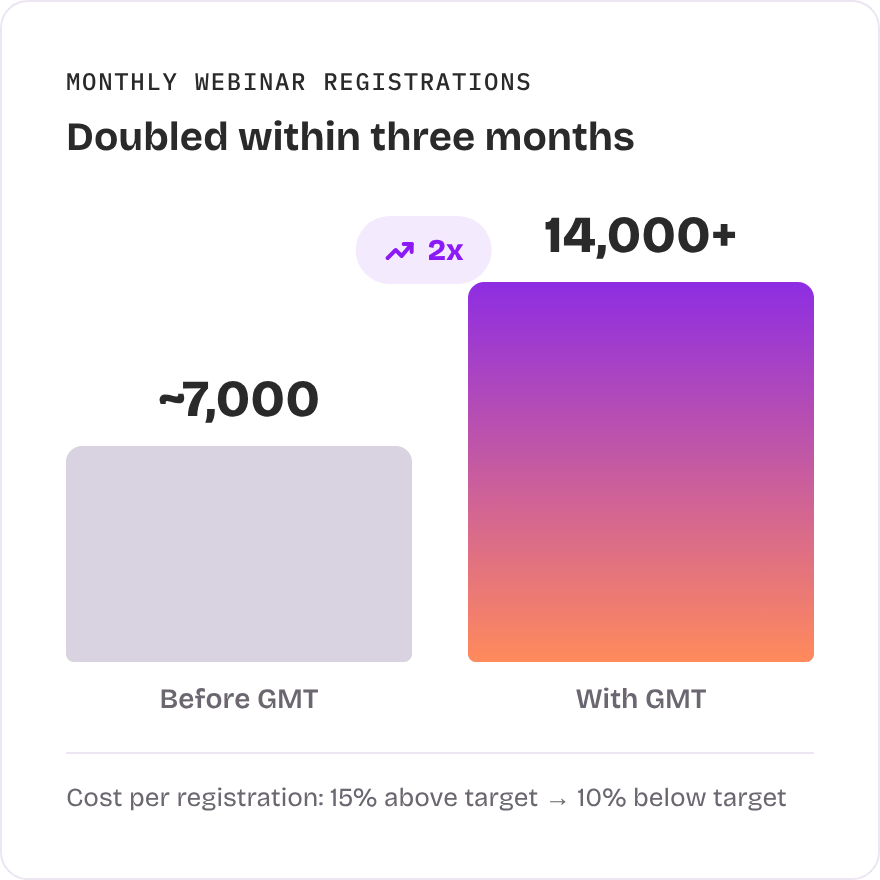
In three months, GMT helped our client, a leading college admissions company, double monthly webinar registrations while cutting cost per registration by roughly a quarter.
2x
monthly webinar registrations
+85%
monthly Meta webinar budget vs. the pre-GMT baseline
CPR Below Target
10% below target cost per registration, down from 15% above target
10% below target cost per registration, down from 15% above target
Client
A leading college admissions counseling company
Target audience
Families of college-bound students
Channels
Meta (Facebook and Instagram), with CAPI tracking via HubSpot
Data timeframe
2026
01 · The challenge
More webinars, flat registrations
By June 2026, the client’s free webinars, its main top-of-funnel engine, had stalled. The company had scaled from six to nine webinars a month, but registrations hadn’t followed.
Busy season was already underway when GMT took over the account, so results had to show up within weeks. Here’s what we walked into:
02 · OUR APPROACH
A funnel problem, not just an ad problem
The number of leads the client could buy at a given cost depended on its ads and its webinar experience working together, so we worked both ends. After two weeks of onboarding, with access to every relevant marketing tool and deep dives with the client’s paid social, lifecycle and webinar teams, the plan rested on four principles.
1
Fix the signal first
Get registration and consult data flowing back to Meta through the Conversions API (CAPI) so the algorithm could optimize on real outcomes.
2
Feed Meta more creative
Add GMT’s creative team alongside the client’s designer to raise volume and variety.
3
Optimize for consults, not just sign-ups
Judge every webinar topic and audience by booked and attended consults and revenue, not cost per registration alone.
4
Change one thing at a time
Run controlled tests so the team could see what actually moved results.
03 · EXECUTION
Working both ends of the funnel
Six workstreams across tracking, campaign structure, creative and the webinar experience itself.
1
Tracking that Meta could learn from
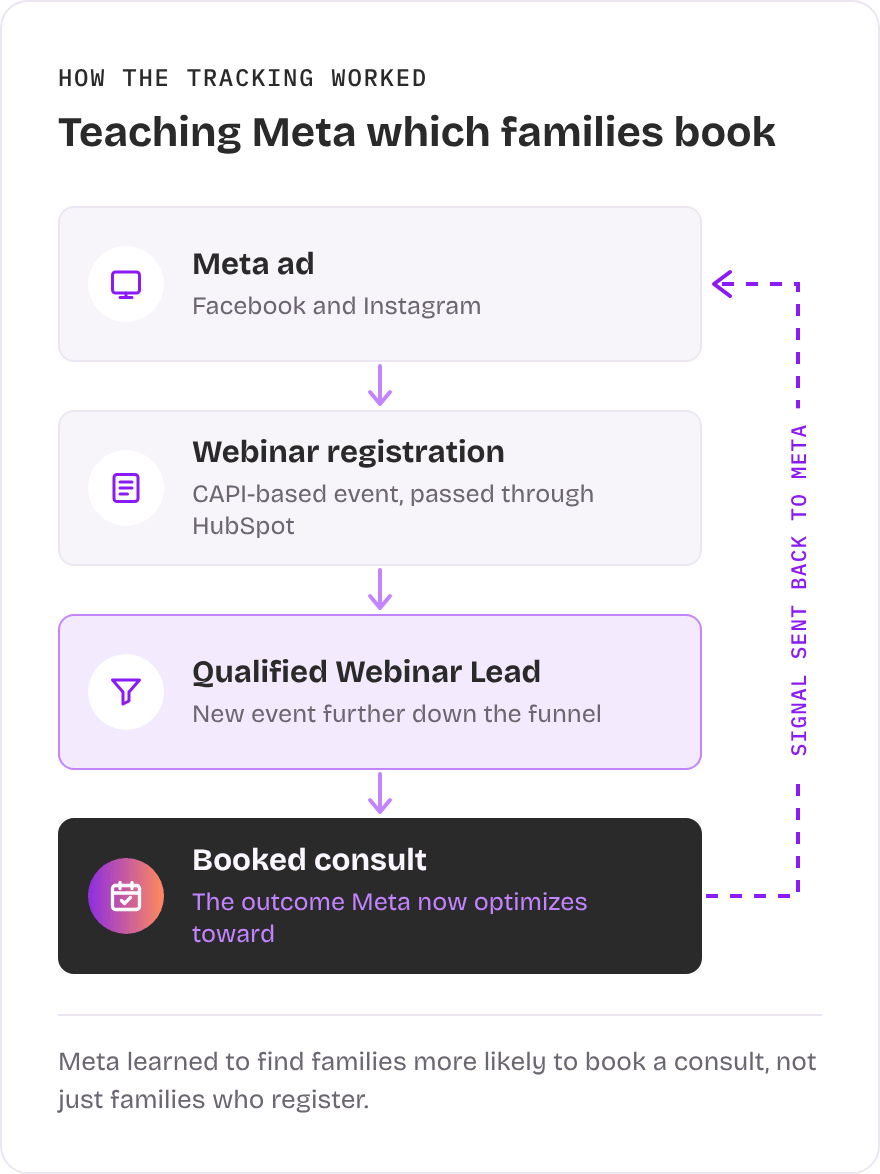
By August, every webinar campaign optimized to a CAPI-based registration event, passed through HubSpot. We then pushed further down the funnel, building a Qualified Webinar Lead event so Meta could find families more likely to book a consult.
2
Rebuilt campaign structure
We kept what was working and layered tests on top, one webinar topic at a time. When class-year mix skewed too far, we tightened parent age targeting, cut low-value placements like Audience Network, and tested new audiences.
3
More creative, faster
GMT’s creative team produced new concepts for each webinar. We spotted creative fatigue early and identified which creatives brought in lower-quality registrants, which shaped our refresh rules.
4
Webinars built to book consults
Together with the client, we rebuilt a reusable webinar flow and updated the sales pitch. The webinar team rolled that approach out across its decks, and GMT kept reviewing recordings to tighten the close.
5
Topic strategy tied to revenue
We built a Webinar Topic Revenue Dashboard that tied Meta spend per topic to CRM data. Combined with competitor webinar research, it shaped a new topic roadmap.
6
Show-up rate as a shared metric
In late July, GMT flagged a few webinars with unusually low show-up rates even though ad metrics looked healthy. The alert helped the client find and fix broken reminder workflows.
04 · RESULTS
Registrations doubled in three months
Within three months, the webinar program was growing again: registrations doubled, cost per registration fell below target, and the client nearly doubled its monthly Meta budget for webinars.
The consult side moved too: a new all-time daily record for booked consults, a new all-time weekly record, and about 15% of registrations now come from families signing up for more than one webinar.
~16%
landing page conversion, stabilized after a long decline
~15%
of registrations now come from families signing up for more than one webinar
Record
new all-time daily and weekly highs for booked consults
05 · IN THEIR WORDS
“
They closed the registration volume gap
I want to shout out [the GMT team] for their hard work on Meta over the last few days in particular! They’ve managed to help close the webinar registration volume gap, all while keeping us right on pace budget-wise. Thanks for your proactive questions, creativity, and commitment to the webinar program!
GMT client
Leading college admissions counseling company
06 · TAKEAWAYS
What EdTech marketers can take from this
Four lessons for any team running webinars as a growth engine.
1
Treat the webinar as part of the ad
Ads, reminders, and the webinar’s closing pitch together decide what a registration is worth.
2
Give Meta better signals
CAPI and down-funnel events like qualified leads let the algorithm find families who book, not just families who click.
3
Creative volume is a growth lever
Under Meta’s current delivery system, a steady flow of new concepts beats re-running past winners.
4
Measure topics by revenue
A cheap registration on the wrong topic, or from the wrong grade level, costs more downstream.
See What This Approach Could Do for Your Business
Every business has different acquisition challenges. Let’s look at your current strategy, identify opportunities, and discuss what could work for you.

Full-funnel growth agency for EdTech. Led by
marketers who scaled EdTech unicorns into
public companies.
© 2026 Growth Marketing Team. All rights reserved.