
Growth Marketing Team Logo

For education & EdTech growth teams

Close the gap and keep increasing
MQLs asad spend scales.​

Find out if all best practices are implemented on
your ad channels.

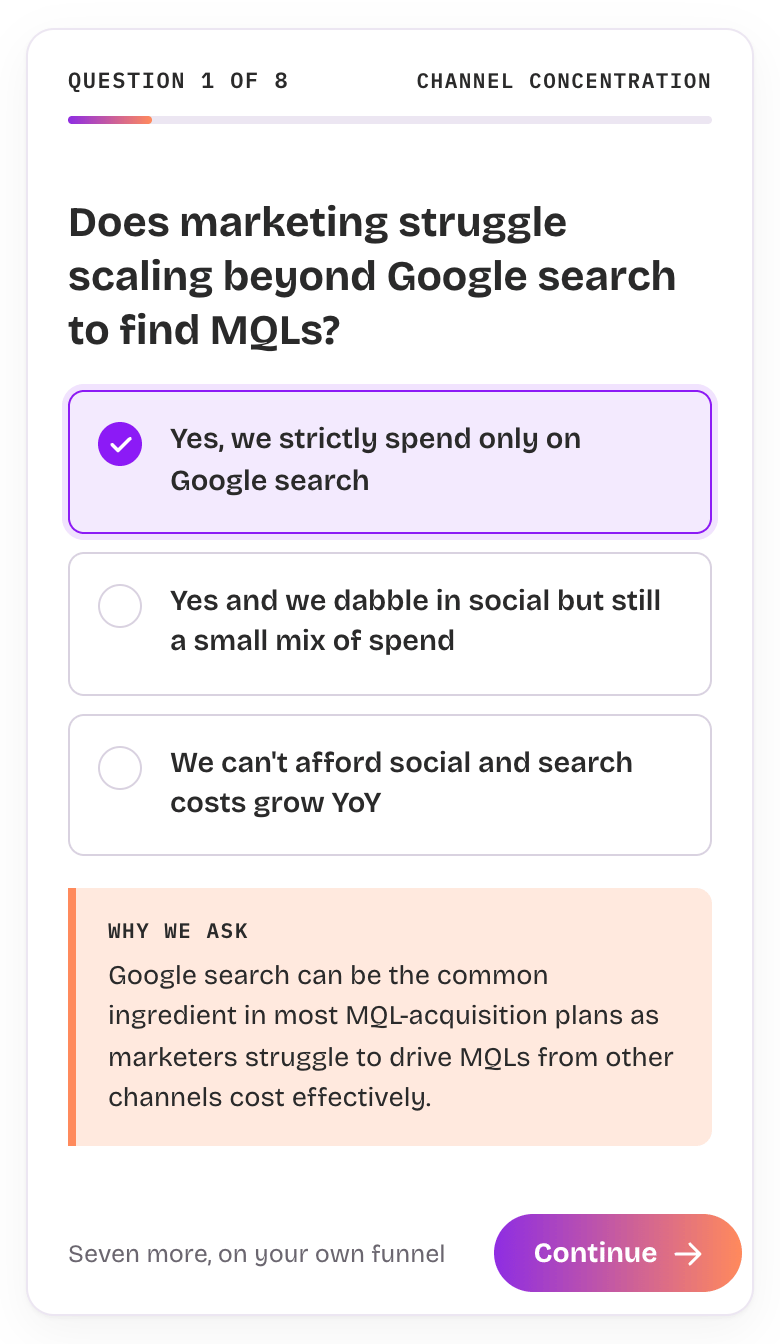
Eight questions, about six minutes.
​
You finish with the one area to open first and the reasoning behind it.

For education &
EdTech growth teams

Close the gap and keep increasing
MQLs asad spend scales.​

Find out if all best practices are implemented
on your ad channels.

Eight questions, about six minutes.
​
You finish with the one area to open first and the reasoning behind it.
Proof first

Leaders Who Have Already
Done This With Us.

Proof first

Leaders Who Have Already Done This With Us.

From the GMT team

How we approach a lead quality problem before touching the account.

Miriam Lopez, co-founder of GMT, on why the first move is rarely a targeting change, and what we look at instead.

0:00 / 0:00

01.

Why the account is rarely the first place to look

A campaign doing exactly what it was asked to do can still produce a falling qualified rate.

02.

Why the two teams disagree

Marketing and admissions are usually both right, which is itself a signal about where to look.

03.

What we examine together

Media, search behaviour, audience hygiene, CRM records and admissions outcomes, read as one system.

Nothing to prepare.
​
Every question is about a funnel you already
know inside out.

From the GMT team

How we approach a lead quality problem before touching the account.

Miriam Lopez, co-founder of GMT, on why the first move is rarely a targeting change, and what we look at instead.

0:00 / 0:00
0:00 / 0:00

From the GMT team

01.

Why the account is rarely the first place to look

A campaign doing exactly what it was asked to do can still produce a falling qualified rate.

02.

Why the two teams disagree

Marketing and admissions are usually both right, which is itself a signal about where to look.

03.

What we examine together

Media, search behaviour, audience hygiene, CRM records and admissions outcomes, read as one system.

Nothing to prepare.
​
Every question is about a funnel you already know inside out.

Where the questions
come from

Built from acquisition work,
not from a content brief.

These are the six areas we work through when an education client tells us qualified rate is falling. Two cases below. In the first the constraint was invisible from media reporting alone. In the second the budget never moved and the qualified numbers did.

The problem

At Sessions College, Google Ads was the largest lead source and volume was healthy. Admissions had historically seen lead quality decline as spend increased, which had become an accepted limit on how far the channel could be pushed.

What GMT found

Connecting CRM dead-lead information with keyword-level paid search performance identified a non-performing search term. That connection was the point. Neither the media reporting nor the CRM showed it on its own.

What changed

Audiences and exclusions were refreshed, targeting was tightened, and the feedback loop between downstream CRM information and the advertising platforms was improved.

+23%

Google spend scaled
year on year

−32%

Cost per MQL

−18%

CPA

The lesson is not that this was a measurement problem. It is that media performance, search behaviour, targeting, audience hygiene, CRM quality and admissions outcomes had to be examined together before the constraint became visible.

Second case · Audience hygiene and Ad signal

The same Meta budget,
68% more qualified leads.

A B2B workforce upskilling business running Meta lead generation. Between June and September 2025 monthly spend stayed
within a few hundred dollars of $27K. Nothing was bought in greater quantity. What changed was who Meta was allowed to reach,
which profile it was told to value, and what came back from the CRM afterwards.

+68%

MQL+ volume

111 to 186, June to September

−32%

Cost per MQL

$244 down to $149

+13.8 pts

MQL+ per Meta lead

22.2% up to 36.0%

~+2%

Meta spend

$27.1K to $27.6K, broadly stable

Month on month, June to September 2025

MetricJunJulAugSep
Meta spend$27,053$27,180$28,389$27,624
MQL+111127184186
Cost per MQL+$244$214$154$149
MQL+ / Meta leads22.2%22.8%37.2%36.0%

The lead-quality refinements went in during July. The step change appears the month after,
which is what a signal and audience fix usually looks like rather than a media one.

Where the questions
come from

Built from acquisition work,
not from a content brief.

These are the six areas we work through
when an education client tells us qualified rate is falling. Two cases below. In the first the constraint was invisible from media reporting alone. In the second the budget never moved and the qualified numbers did.

The problem

At Sessions College, Google Ads was the largest lead source and volume was healthy. Admissions had historically seen lead quality decline as spend increased, which had become an accepted limit on how far the channel could be pushed.

What GMT found

Connecting CRM dead-lead information with keyword-level paid search performance identified a non-performing search term. That connection was the point. Neither the media reporting nor the CRM showed it on its own.

What changed

Audiences and exclusions were refreshed, targeting was tightened, and the feedback loop between downstream CRM information and the advertising platforms was improved.

+23%

Google spend scaled
year on year

−32%

Cost per MQL

−18%

CPA

The lesson is not that this was a measurement problem. It is that media performance, search behaviour, targeting, audience hygiene, CRM quality and admissions outcomes had to be examined together before the constraint became visible.

Second case
Audience hygiene and Ad signal

The same
Meta budget,
68% more qualified leads.

A B2B workforce upskilling business running Meta lead generation. Between June and September 2025 monthly spend stayed within a few hundred dollars of $27K. Nothing was bought in greater quantity. What changed was who Meta was allowed to reach, which profile it was told to value, and what came back from the CRM afterwards.

+68%

MQL+ volume

111 to 186, June to
​September

−32%

Cost per MQL

$244 down to
$149

+13.8 pts

MQL+ per Meta lead

22.2% up
to 36.0%

~+2%

Meta spend

$27.1K to $27.6K, broadly stable

Month on month,
June to September 2025

MetricJunJulAugSep
Meta spend$27,053$27,180$28,389$27,624
MQL+111127184186
Cost per MQL+$244$214$154$149
MQL+ / Meta leads22.2%22.8%37.2%36.0%
MetricJunJulAugSep
Meta spend$27,053$27,180$28,389$27,624
MQL+111127184186
Cost per MQL+$244$214$154$149
MQL+ / Meta leads22.2%22.8%37.2%36.0%

The lead-quality refinements went in during July. The step change appears the month after,
which is what a signal and audience
fix usually looks like rather than a media one.

Inside This FREE Presentation You'll Learn:

Arrows Down.svg
Group.png

01:37 – How Dan Henry started using THIS exact webinar strategy to pay off his huge IRS bill.

Group.png

17:12 – The exact stories you SHOULD use inside of your webinar to convert your audience into buyers.

Group.png

44:05 – How Dan's client went from charging $1,500 to charging $1-$3 MILLION dollar contracts.

Group.png

Watch the end of this video to get Dan's funnel installed directly into your ClickFunnels account.

01.
CRM audience hygiene and automated exclusions

Client-side CRM audiences kept refreshed and synced, so churned users, opted-out contacts and other poor-fit records left the pools. Backend seat-size segments now sync into Meta and are excluded from acquisition automatically. 

02.
Seat-size segmentation and lead scoring

A lead-scoring approach introduced, with 25+ technicians set as the priority profile, so the larger opportunities were distinguishable from small accounts.

03.
Enterprise-focused creative and messaging

Angles and copy rebuilt around seat count and enterprise-scale needs. More relevant to larger-seat prospects and deliberately less attractive to small, low-value enquiries.

04.
Enterprise-focused creative and messaging

Audience Network removed and delivery focused on Feeds, Stories and Reels, weighted toward the placements producing stronger downstream leads.

05.
Audience strategy and tracking refinement

Continued audience testing, leaning into Lookalikes where they scaled, alongside better UTM, content and segmentation visibility so campaign decisions were made against cleaner information.

Inside This FREE Presentation You'll Learn:

Arrows Down.svg
Group.png

01:37 – How Dan Henry started using THIS exact webinar strategy to pay off his huge IRS bill.

Group.png

17:12 – The exact stories you SHOULD use inside of your webinar to convert your audience into buyers.

Group.png

44:05 – How Dan's client went from charging $1,500 to charging $1-$3 MILLION dollar contracts.

Group.png

Watch the end of this video to get Dan's funnel installed directly into your ClickFunnels account.

01.

CRM audience hygiene and automated exclusions

Client-side CRM audiences kept refreshed and synced, so churned users, opted-out contacts and other poor-fit records left the pools. Backend seat-size segments now sync into Meta and are excluded from acquisition automatically. 

02.

Seat-size segmentation and lead scoring

A lead-scoring approach introduced, with 25+ technicians set as the priority profile, so the larger opportunities were distinguishable from small accounts.

03.

Enterprise-focused creative and messaging

Angles and copy rebuilt around seat count and enterprise-scale needs. More relevant to larger-seat prospects and deliberately less attractive to small, low-value enquiries.

04.

Enterprise-focused creative and messaging

Audience Network removed and delivery focused on Feeds, Stories and Reels, weighted toward the placements producing stronger downstream leads.

05.

Audience strategy and tracking refinement

Continued audience testing, leaning into Lookalikes where they scaled, alongside better UTM, content and segmentation visibility so campaign decisions were made against cleaner information.

Four of those five changes are about what the platform was told, not what it was paid. Cost per qualified lead fell while volume rose, which only happens when the improvement comes from who is being reached rather than from buying more of the same.

Four of those five changes are about what the platform was told, not what it was paid.
Cost per qualified lead fell while volume rose, which only happens when the improvement comes
from who is being reached rather than from buying more of the same.

Reasonable questions

What this can
and cannot
tell you.

1. Our CPL is improving but qualified volume is flat. Is that a lead quality problem?

It is one of the clearest signals of one. Cost per lead and cost per qualified lead can move in opposite directions, and when they separate it usually means the platform is getting better at finding people who convert on the form rather than people who qualify. Before treating it as a media problem, check whether your qualified event is reaching the platform at all. If it is not, the algorithm is optimising toward the only outcome it can see.

2. Marketing and admissions disagree about lead quality. Who is usually right?

Both, and that is the point. In most education businesses the two teams apply different tests for a qualified lead, so they can describe the same month accurately and reach opposite conclusions. That disagreement is diagnostic in itself. Until there is one written definition covering lead, qualified lead, application and enrolment, no campaign change can be proven to have worked.

3. What should we check before changing targeting, creative or budget?

Whether the reporting behind the decision can be trusted. If downstream outcomes are not reaching Meta or Google, or the campaign reference does not survive on the CRM record, then any change you make will be unreadable afterwards. The most common wasted quarter we see starts with a targeting change made before anyone confirmed the measurement was sound.

4. Should we fix this in house or bring in an education marketing agency?

It depends where the break sits. Definition, CRM hygiene and admissions handoff are usually faster and cheaper to fix in house, because they need internal agreement more than external skill. Tracking architecture, feedback loops and optimisation signal are where an education marketing agency earns its fee, since those need people who rebuild them regularly. Run the diagnostic first. If it points at definition, you probably do not need anyone external yet.

5. Does an EdTech marketing agency need category experience, or is paid media the same everywhere?

The platform mechanics transfer. The funnel does not. Education has long consideration windows, an admissions or sales stage between the lead and the revenue, and enrolments that often complete offline, which means a general growth marketing agency can run the account correctly and still optimise toward the wrong event. The same applies to a higher education digital marketing agency working across programmes with different intake cycles. Ask any prospective partner what they would send back to the platform, and when.

Reasonable questions

What this can and cannot
tell you.

1. Our CPL is improving but qualified volume is flat. Is that a lead quality problem?

It is one of the clearest signals of one. Cost per lead and cost per qualified lead can move in opposite directions, and when they separate it usually means the platform is getting better at finding people who convert on the form rather than people who qualify. Before treating it as a media problem, check whether your qualified event is reaching the platform at all. If it is not, the algorithm is optimising toward the only outcome it can see.

2. Marketing and admissions disagree about lead quality. Who is usually right?

Both, and that is the point. In most education businesses the two teams apply different tests for a qualified lead, so they can describe the same month accurately and reach opposite conclusions. That disagreement is diagnostic in itself. Until there is one written definition covering lead, qualified lead, application and enrolment, no campaign change can be proven to have worked.

3. What should we check before changing targeting, creative or budget?

Whether the reporting behind the decision can be trusted. If downstream outcomes are not reaching Meta or Google, or the campaign reference does not survive on the CRM record, then any change you make will be unreadable afterwards. The most common wasted quarter we see starts with a targeting change made before anyone confirmed the measurement was sound.

4. Should we fix this in house or bring in an education marketing agency?

It depends where the break sits. Definition, CRM hygiene and admissions handoff are usually faster and cheaper to fix in house, because they need internal agreement more than external skill. Tracking architecture, feedback loops and optimisation signal are where an education marketing agency earns its fee, since those need people who rebuild them regularly. Run the diagnostic first. If it points at definition, you probably do not need anyone external yet.

5. Does an EdTech marketing agency need category experience, or is paid media the same everywhere?

The platform mechanics transfer. The funnel does not. Education has long consideration windows, an admissions or sales stage between the lead and the revenue, and enrolments that often complete offline, which means a general growth marketing agency can run the account correctly and still optimise toward the wrong event. The same applies to a higher education digital marketing agency working across programmes with different intake cycles. Ask any prospective partner what they would send back to the platform, and when.

Find the first
place worth investigating.

Eight questions on your own funnel. You get the area to open first, the reasoning behind it, and the one thing to leave alone until you have looked.

No email, no call and no form before your result.
If you want a second opinion on what it surfaces, that offer is waiting on the result screen.

Find the first
place worth  investigating.

Eight questions on your own funnel.
You get the area to open first, the reasoning behind it, and the one thing to leave alone
until you have looked.

No email, no call and no form before your result.
If you want a second opinion on what it surfaces,
that offer is waiting on the result screen.